Climate
CO2 (carbon dioxide)
& the Greenhouse Effect
- Is climate change “real” or a hoax?
- What factors affect temperature (in addition to CO2)?
- What causes climate change?
- How does the “greenhouse effect” work?
- Is carbon dioxide the primary greenhouse gas?
- Are increases in CO2 responsible for global temperature changes? Or are other factors at work?
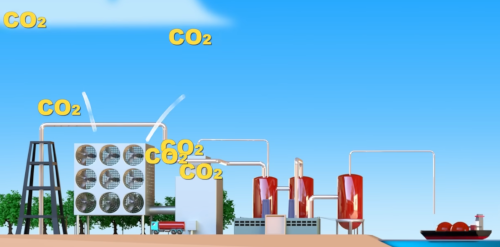
- Is CO2 a pollutant, and should we try to eliminate it?
- How much are humans responsible for CO2 increases?
- Can we predict future climate changes?
- Is “climate change” producing more cases of “extreme weather” (more wildfires, flooding, etc.)?
- Should we be abandoning fossil fuels and moving to more “sustainable” energy sources?
- Is the IPCC a reliable source of science information on climate?
- Is the science “settled”?
- And more ...
- What scientific evidence do you rely on?
- What Coefficient of Correlation between CO2 and temperature do you use? Over what period of time?
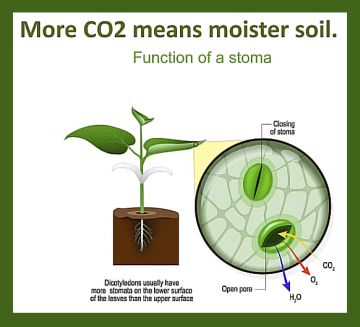
- What are the costs, and what are the benefits, of a world that has 800 ppm of CO2 and is 2°C warmer than today? What is wrong with a warmer world with more plant food (CO2 is a fertilizer) anyway?
- Is it cheaper and more certain to adapt to climate change than to attempt to mitigate (prevent) climate change?
- What if most countries do not honour their CO2 reduction commitments (as the vast majority will not)? What then?
- Are you personally willing to risk US$34,000 for every human being on earth over the next 26 years to test the anthropogenic global warming alarmists' hypothesis? I am NOT.
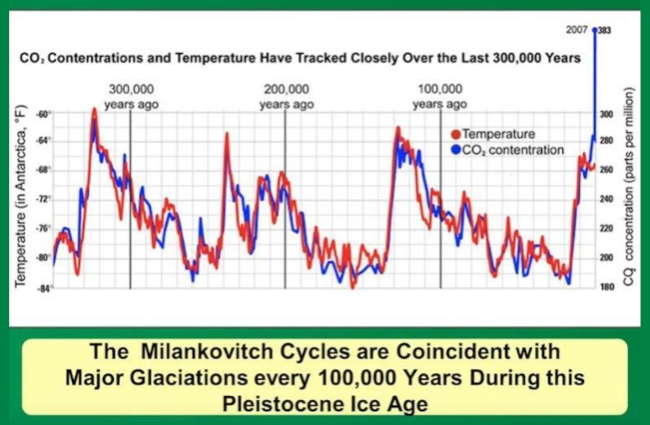
Numerous scientists have identified the SUN as the main cause of climate change! For instance, the Milankovitch Cycles explain changes in the Earth's climate and surface temperature as the Earth's orbit cyclically changes the distance from the Sun and its axial tilt to the Sun. Milutin Milankovitch, a Serbian geologist and astronomer, also observed a 0.9 (90%) correlation between the number of sunspots and the temperature on Earth (more sunspots = more warming and vice-versa).
Other factors that affect the Earth's climate and surface temperature are:
- variations in the Sun's luminosity and spectral distribution
- variations in the Earth’s magnetic field
- variations in cosmic rays
- variations in cloud cover
- variations in the Tropopause Inversion Layer
- the amount of heat stored in, released from, or transported by the oceans and their currents
- cyclical local changes in ocean currents (El Nino, La Nina, AMO, etc.)
- the Earth's atmosphere itself, including changes in cloud cover
- Volcano eruptions. (On January 15, 2022, the Hunga Tonga submerged eruption increased atmospheric water vapour, the major greenhouse gas, by approximately 13%).
The Sun causes climate change not only on Earth, but on other planets and moons in our solar system. Habibullo Abdussamatov has asserted that "parallel global warmings — observed simultaneously on Mars and on Earth — can only be a straight-line consequence of the effect of the one same factor: a long-time change in solar irradiance." Link to H.I. Abdussamatov, "The new Little Ice Age has started".
Original research by Tom Gallagher, a Canadian geoscientist, has found strong correlations between major temperature changes and continental drift, which has opened and shut gates such as the Bering Strait and Panama Isthmus, as well as the flow through the Mediterranean and the Arabian Gulf north of India, before India became attached to Asia. Gallagher also points to the role of the oceans as a store of 83% of the Earth's CO2 and a store and transporter of energy over time and around the world.
From his research Gallagher concluded that "CO2 and temperature proxies do not correlate in geologic climate data" and that over geological time there is a very weak, negative correlation between CO2 and temperature - a slight inverse correlation. His video is available at: https://youtu.be/K6tWEjkEiZU.
To argue that CO2 is the thermostat regulating the earth’s temperature, one must prove a positive correlation, and preferably a strong correlation, exists between CO2 and temperature.

Understanding Climate Change
"Humans tend to abhor change. A lot of people like things "just the way they are now", and believe that the climate we have been enjoying for the past few decades is "perfect" for them. But it is the height of arrogance and selfishness to believe that present conditions are ideal for us, and that we have the ability to control the climate so that it stays this way! The best recommendation that can be given is that man must learn to adapt to the continually changing climate.
There are a large number of factors that affect the earth's climate. Many of these are poorly understood by man, and there are some factors that probably haven't even been discovered yet.
A number of conclusions can be taken away from the information presented so far in this document:
- Climate change is a naturally-occurring, cyclic phenomena, and it has been going on for millions of years.
- Climate change is primarily driven by changes in the energy of the sun that impinges on the earth. The dominant factors driving this are variations in the sun (total output power, spectral distribution, sunspot cycles) Milankovitch Cycles, variations in ocean currents (ENSO, PDO, and AMO). Other factors include the effect of varying cosmic particle influx and high altitude bacteria, causing changes in cloud cover.
- The primary greenhouse gas is water vapour. The effect of atmospheric CO2 on global temperature change is much less. Because of the non-linear effect of CO2 concentration, increases beyond the current level will have a decreasing effect on the earth's climate. (it is sometimes stated that CO2's Greenhouse Effect is becoming "saturated")
- Man-made CO2 does have a minor effect on global temperature changes, but it is not the dominant factor. A reduction of man-made CO2 emissions would have a negligible effect on global temperature.
- Man's understanding of the various climate-influencing factors is very limited.
- Climate models are not effective at forecasting future long-term global temperatures.
- There is very little that mankind can do to affect global temperature change. It does not make sense to introduce regulations that will have a negative impact on Western economies in a pointless attempt to change the natural rate of global climate change.
- Mankind will have to learn to adapt to future climate changes. If mankind is still around in a few thousand years, they will then have to adapt to global cooling and glaciations!

- Historical Perspectives on CO2 & Climate;
- Modern CO2 Measurements & Observations;
- CO2 Measurements in Geneva;
- Historical CO2 Data & Its Implications;
- CO2 Variations & Climate Science;
- Critique of CO2 Measurement Methods;
- CO2 Levels During COVID-19;
- Debate on Antarctic Ice Core Data;
- CO2 Distribution & the Keeling Curve;
- The Role of CO2 in Climate Change;
- CO2 Emissions & Global Impact;
- Concluding Thoughts on CO2 & Climate.

How can you spread the message that They Lied?


Stay up to date with our Newsletter
or subscribe below ...
Click here to STOP the Globalist Agenda
Click here to support our work.
Click here to email us at contact@theylied.ca
